Personal Profile Collections
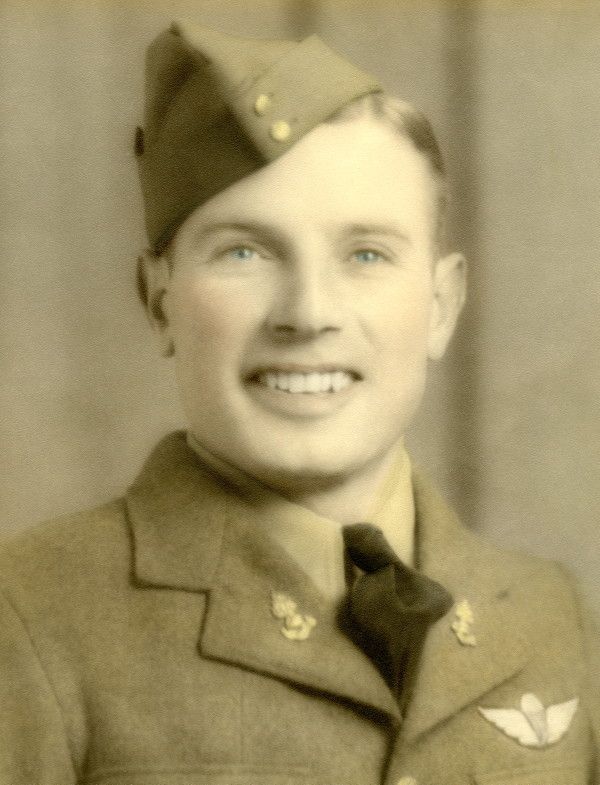
F31928 Pte. Alexander Joseph (Scotty) MacInnis
Killed in Action June 6, 1944
Short Biography:
Alexander Joseph MacInnis, was born in Sydney, NS, on February 9, 1916, the son of Daniel and Jane (MacEachern) MacInnis. He was more commonly known by the nickname Scotty. He came from a large family and had three brothers and seven sisters plus three other siblings that died before the war. The family home was on Alexandra Street in Sydney. Scotty dropped out of school, after completing Grade 10, to join the workforce. At various times, he worked as a truck driver, a carpenter, a pipe fitter, a roofer and a painter. He was physically fit and enjoyed playing sports and could sing well.
On July 21, 1942, at the age of 26, Scotty enlisted in the army. He signed up in Sydney and requested the paratroopers, a new branch of service in the Canadian Army. Probably due to his work experience in the trades and construction, for training purposes, he was assigned to the Royal Canadian Engineers. He was sent to the #61 Canadian Army Basic Training Centre in New Glasgow where he completed his basic training. While there, he was admitted to hospital for six days with a case of tonsillitis. At the end of September, 1942, Scotty was transferred to the Canadian Engineer Training Centre in Petawawa, Ontario for further training. His rank was changed from private to sapper. In November, 1942, he was approved for the paratroopers and was attached to the 1st Canadian Parachute Battalion.
The 1st Canadian Parachute Battalion was authorized on July 1, 1942. It was a new branch of the Canadian Army. There were no parachute training facilities in Canada at the time, so new recruits were sent to Fort Benning, Georgia, in the United States, and to RAF Ringway in England.
Scotty was one of the new recruits selected to go to Fort Benning to undergo rigorous paratrooper training. He was sent there at the end of November, 1942 and completed his jump training and qualified as a parachutist on January 1, 1943. He retained his engineer rank of sapper until he received his qualification, at which time his rank changed back to private. Due to the inherent dangers entailed as a paratrooper, he received an increase in his pay. After a two week furlough, Scotty was transferred to the newly opened Canadian Parachute Training Wing at Camp Shilo, Manitoba. In July, 1943, Scotty shipped out for England with the rest of his battalion. In England, the 1st Canadian Parachute Battalion came under the command of the 3rd Parachute Brigade of the British 6th Airborne Division. The battalion then spent the next year training for airborne operations.
The 1st Canadian Parachute Battalion went into action for the first time in the early morning hours of June 6, 1944, D-Day, the beginning of the Allied invasion of occupied France. On the evening of June 5, 1944, the battalion was transported to France in fifty aircraft and landed in the dark, one hour in advance of the rest of the brigade. They were the first Canadian troops on the ground in France as part of the Normandy invasion. Their initial mission was to secure the drop zone for the remainder of the brigade. Afterwards, the battalion was to destroy road bridges over the River Dives and its tributaries and then neutralize strong points at a crossroads. In addition, they were to protect the left flank of the 9th Battalion during that unit’s attack on the Merville Battery and seize the Le Mesnil crossroads, a vital position in the area. The battalion achieved all of its D-Day objectives even though heavy anti-aircraft fire, adverse weather conditions and poor visibility scattered the unit over a wide area of the countryside.
Scotty was a member of “B” Company whose mission was to destroy two bridges over the River Dives. He jumped with the rest of his stick of 20 men at 12:45 am and was never seen again. Because the unit was so scattered and they were dropped so far from their intended targets, only a handful of the twenty men met up immediately after the landing. Later, all were accounted for except Scotty. After the battle and again after the war, Canadian authorities received statements from some of the men that were in the plane with Scotty, but there was no conclusive proof of what happened to him after he exited the plane, and his body was never recovered. Scotty was initially reported as missing but later officially reported as presumed killed in action. He was 28 years old.
Scotty’s name is memorialized on the Bayeux Memorial, located on the outskirts of the town of Bayeux, Calvados, France. The memorial was erected in honour of the 1803 men of the Allied land forces who died in the fighting in Normandy and in the advance to the River Seine, and who have no known graves.
Unless otherwise noted, all photos, artifacts and documents were donated to the Cape Breton Highlanders Military Museum by Donnie Campbell, nephew of Pte. Alexander Joseph (Scotty) MacInnis.