Personal Profile Collections
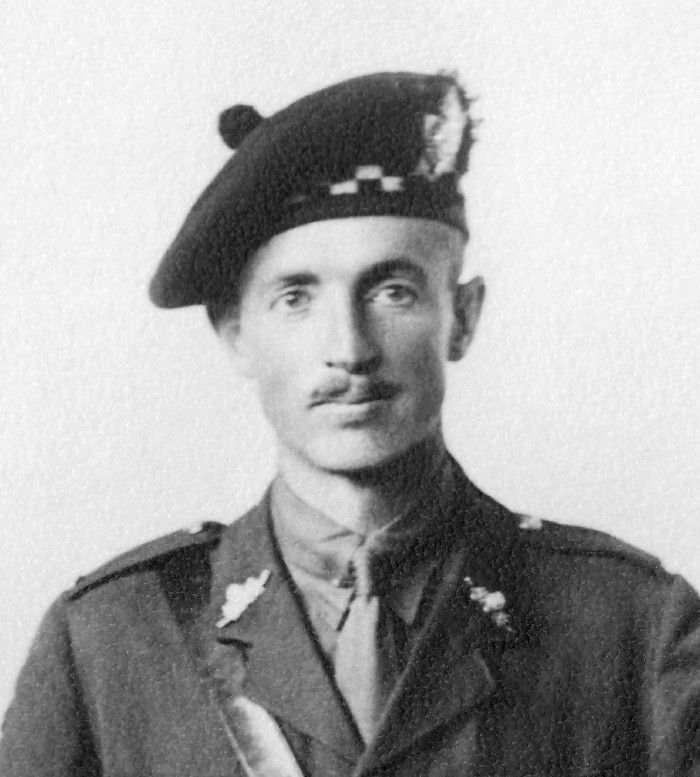
Henry McLaren Wylie
Service Number 222139
Short Biography:
Henry McLaren Wylie was born in Dundas, Ontario, on September 23, 1879, the son of James H. and Maria Elizabeth Wylie. He was living in Halifax and working as a tea broker when he enlisted in the 85th Battalion (Nova Scotia Highlanders) on September 25, 1915. He had married Kathleen MacKinlay and they had two young girls together. At the time of his enlistment, he was 36 years old. Henry had prior militia experience with the 81st Hants Regiment and had spent three months with the Queens Own Rifles of Canada. Henry enlisted with the rank of private and was soon promoted to sergeant. He took six weeks officer training at Dalhousie University in Halifax, and by February, 1916, he was appointed to the commissioned rank of lieutenant.
Henry trained with the 85th Battalion in Halifax and later at the large prewar military base in Aldershot, NS, where the 85th Battalion was united with its newly raised sister battalions to form the Nova Scotia Highland Brigade. In October, 1916, four highland battalions of the brigade (85th, 185th, 193rd and 219th) departed Halifax for England on the RMS Olympic, a former luxury liner converted to a troop ship. Once there, they were moved to Witley Camp, Surrey, in the south of England, for further training.
Shortly after arriving in England, news was received that some of the Nova Scotia highland battalions were to be disbanded with the men to be used as reinforcements for units already at the front. The 193rd and 219th Battalions were dissolved, the 185th Battalion was to remain in England, and Henry’s unit, the 85th Battalion, was to proceed to France. On February 10, 1917, the 85th Battalion crossed the English Channel and disembarked at Boulogne. They soon found themselves at the front as a work battalion. Their status changed to a fighting battalion on April 9, 1917, during the Battle for Vimy Ridge, when the 85th Battalion was ordered to attack Hill 145. It was one of the last positions on the ridge still held by the Germans, even after repeated attacks by other Canadian units. The 85th Battalion distinguished themselves when a two company direct assault on the hill, without the aid of an artillery barrage, and after intense fighting, swept the Germans from their dug in hilltop positions. During the fighting, Henry commanded No. 15 Platoon of “D” Company, one of the two companies in the initial attack, made up of recruits from Cape Breton.
On April 18, 1917, shortly after the battalion’s baptism of fire at Vimy Ridge, Henry fell from his horse and seriously injured his back. He was hospitalized and invalided back to England to recover. While there, he was transferred to the Nova Scotia Regiment Depot and then the 17th Canadian Reserve Battalion. He also took a course in trench warfare. In September, 1917 he rejoined the 85th Battalion in France. Bad luck followed when he sustained an injury to his eye and was again hospitalized in France. After his recovery he was attached for approximately a month to the 12th Canadian Light Trench Mortar Battery. After that he was seconded to a Canadian Corps Reinforcement Camp in France. Henry rejoined the 85th Battalion in October, 1918, but was again seconded to a Canadian Corps Reinforcement Camp the following December. He returned to Canada in early July, 1919 and was demobilized on July 15th.
Back in Halifax, Henry resumed his former career as a tea broker, working as a representative of the Anglo-American Tea Company of Toronto. He passed away after a brief illness, in September, 1936. He was 56 years old. Henry was laid to rest in Pictou, NS, the home town of his second wife, Kathleen Hannon.